
About the course
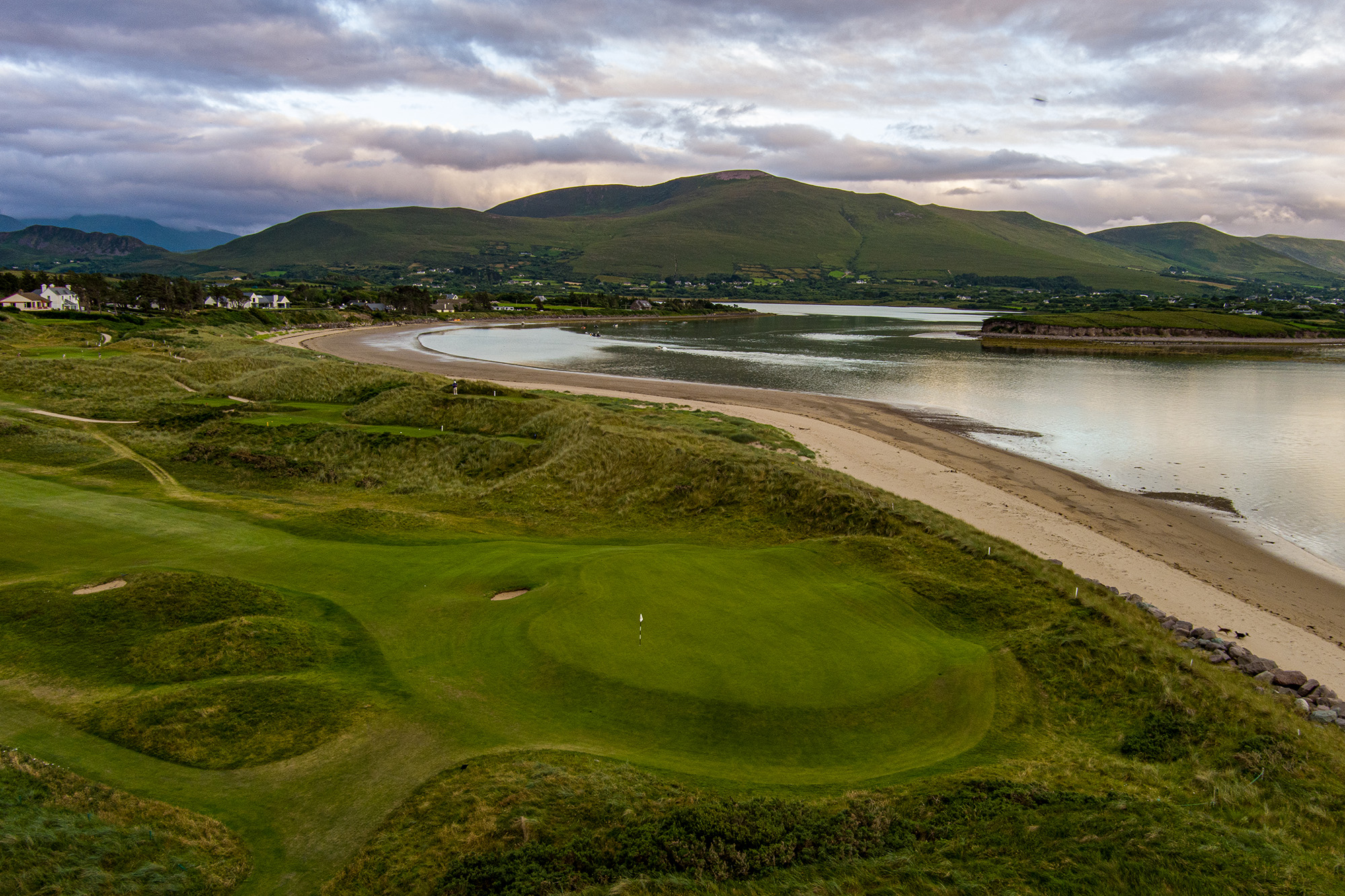
Dooks lies on the north side of the Iveragh peninsula near Glenbeigh, on low links ground beside Dingle Bay, and the mountain range of the Reeks can be seen from almost every hole. The land is a protected habitat for the natterjack toad, one of Ireland’s rarest animals, which lives in ponds on the course and appears on the club’s crest.
The club was founded in 1889 by officers of the Royal Horse Artillery stationed at Glenbeigh, and for most of its first eighty years it was a nine-hole course. When the lease ran out in the 1960s the members raised the money to buy the land, and the course was extended to 18 holes in the early 1970s under the guidance of Eddie Hackett, with members helping to build the new holes. Martin Hawtree later carried out a thorough redesign in the 2000s, adding around 500 yards, rebuilding the bunkers and constructing new greens, ten of them in new positions.
The 1st asks for an accurate drive into a narrow landing area, so there is no gentle start. The 7th is statistically the hardest hole, while the 11th and 13th are short holes where the green sits among the dunes and a precise iron is essential. Hawtree turned the 18th from a par 5 into a par 4 that can be approached with a running shot between the dunes. The prevailing south-westerly wind and firm turf mean the short game is tested on almost every hole.
Why we recommend it
Dooks is one of the oldest clubs in Ireland and still one of the friendliest, set on the shore of Dingle Bay with the Macgillycuddy’s Reeks behind it. The course is not long, but natural undulations, small greens and the Atlantic wind keep every club in the bag busy. It is a relaxed, unpretentious links that suits groups with mixed handicaps. About 35 minutes west of Killarney on the Ring of Kerry, it slots easily between rounds at Waterville and Killarney.
Photo gallery


Video
| Ranking Ireland | 27 |
| Architect | Eddie Hackett |
| Year of foundation | 1889 |
| Par Course | 72 |
| Number of holes | 18 |